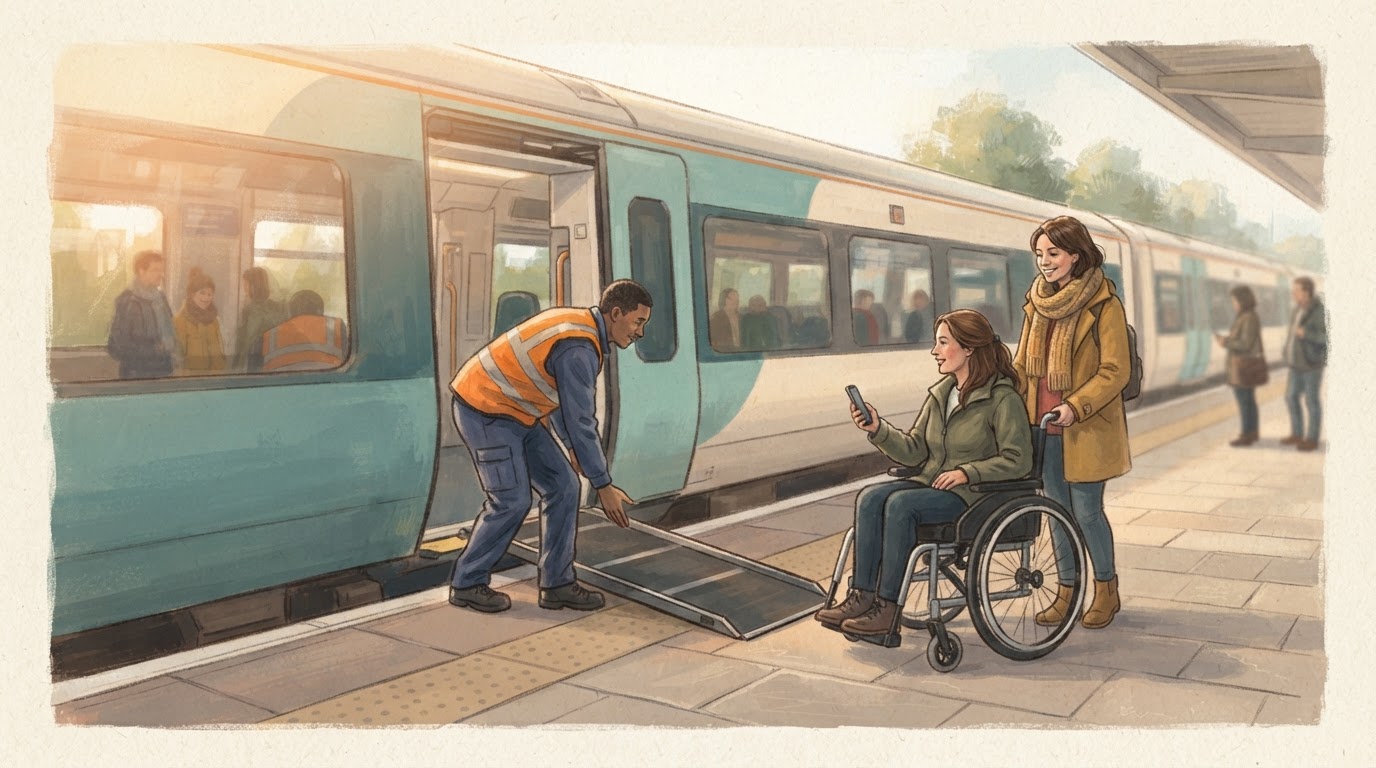
Choosing the lowest-carbon way to travel is one decision. Choosing one that also works for your mobility, sensory or energy needs is another. The trouble is that the two are often planned separately: you find the greenest route first, then discover the station has no step-free access, or that the coach has a single wheelchair space and it sold out last week.
AI travel planners are genuinely useful for the first job. They can compare trains, coaches, ferries and flights in minutes and keep a dozen variables in view at once. They are much less reliable on the second, because accessibility details are specific, local and always changing. This guide shows how to use AI to shortlist sustainable options, then check every one for access before you pay for anything.
In Short
- Use AI to compare low-carbon routes and to write your list of access questions, not to confirm access.
- Verify step-free routes, wheelchair space, ramps and assistance rules with the operator itself.
- Secure assistance and space before, or at the same time as, you buy tickets.
- Plan the last mile and keep an accessible fallback in your back pocket.
Why Sustainable and Accessible Planning Belong Together
The European Environment Agency’s comparison of EU transport modes ranks trains as the most efficient form of passenger transport per passenger-kilometre, with flights and cars among the least efficient (EEA). For many trips, then, the lower-carbon choices are rail, coach, ferry and local electric transit.
Those are also the modes where accessibility depends most on the specific operator, vehicle and station: whether there is a lift at your transfer, whether the train has a space for your wheelchair, whether a ferry’s boarding ramp is usable. The greenest route on a map is only the greenest route if you can actually use it.
Step 1: Let AI Shortlist the Low-Carbon Options
Ask the AI for a comparison, not a verdict. Give it your origin, destination and dates, plus a functional description of what you need, such as “step-free boarding and space for a mobility scooter”. You don’t need to share a diagnosis to get a useful route, and it is sensible to keep personal health details out of general-purpose chat tools.
Here is a prompt you can copy and adapt:
I'm travelling from [origin] to [destination] between [dates]. I need step-free access from street to seat and space for [mobility aid]. Compare train, coach, ferry and flight options by: (1) estimated emissions per passenger, (2) total door-to-door time including transfers, (3) likely step-free access at each station, stop or terminal, and (4) how and when I would request assistance. For every claim about access, name the official page I should check to confirm it, and clearly mark anything you are unsure about.The last sentence does the real work. It forces the AI to separate what it knows from what it is guessing, and it hands you a to-do list of official pages to verify.

Step 2: Turn the Shortlist Into Accessibility Questions
For each option left on your shortlist, write down what must be true for the journey to work. The table below covers the questions that most often decide whether a low-carbon option is realistic.
| Option | Carbon note | Access questions to confirm |
|---|---|---|
| Train | Most efficient long-distance mode in EU data | Step-free route from street to platform; wheelchair space; ramp availability; assistance notice period; lift status at transfers |
| Coach or bus | Efficient, especially when well filled | Number of wheelchair spaces; working lift or ramp; whether you must book directly with the operator; handling of luggage and mobility aids |
| Ferry | Varies by vessel and route | Accessible cabins and seating; lifts between decks; boarding ramp or gangway; assistance at the terminal |
| Tram, metro, city bus | Low-emission local options in many cities | Low-floor vehicles; working ramps; lift outages; space for mobility aids at busy times |
| Flight (for comparison) | Among the highest emissions per passenger-kilometre | How to request airline assistance; how your mobility aid is handled; airport transfers |
Ask the AI to build this table for your specific route, then treat every cell as a question to confirm rather than an answer.
Step 3: Verify With the Operator and Request Assistance
This is the step AI can’t do for you. Operators publish their own accessibility pages and assistance services, and those are the sources that count. Eurostar, for example, asks passengers to pre-book assistance at least 24 hours before departure (Eurostar). Other operators set their own notice periods, sometimes longer for cross-border trips, so never assume the rules for one operator apply to the next.
Be careful with third-party booking platforms too. Rail Europe’s help pages explain that its booking system can’t reserve wheelchair spaces and that these must be arranged with the operator (Rail Europe). If an aggregator or AI assistant offers to “book everything”, check whether wheelchair spaces and assistance are actually included. Often they are not. Rules and notice periods change, so confirm the current details before you buy.

Where you can, get confirmation in writing, such as an email or a booking reference for the assistance request, and save it offline. Note the operator’s helpline number for the day of travel as well.
Step 4: Plan the Last Mile and Keep a Fallback
Many sustainable trips are won or lost in the final few kilometres. Check whether the tram, metro or bus at your destination uses low-floor vehicles with working ramps, and look at live service pages for lift outages on the day you travel. Add buffer time to every transfer: a connection that looks comfortable on a timetable can feel tight when you need a lift or are waiting for a ramp.
Then choose a fallback. An accessible taxi or ride service as plan B doesn’t undo your sustainable choice. It stops the whole plan collapsing if a lift is out of service.

Quick Pre-Booking Checklist
- Shortlist two or three low-carbon options with AI and note the official page for each access claim.
- Confirm step-free access at every station, stop and transfer.
- Confirm wheelchair space, ramp or boarding help with the operator.
- Check the notice period for assistance and submit the request.
- Secure assistance before buying non-refundable tickets, or choose flexible fares.
- Plan the last mile, add buffer time and pick a fallback.
- Save confirmations and helpline numbers offline.
Where to Book Once Access Is Confirmed
Once the operator has confirmed your route, you can book the parts of the trip that sit around it. These three tools fit this stage.
Disclosure: some links in this section are affiliate links. If you book through them, KohsarBlog may earn a commission at no extra cost to you.
- Booking.com: Useful for stays near step-free stations and low-floor transit lines. It offers accessibility-related filters, but treat them as a starting point and message the property to confirm the entrance, lift and bathroom details before you reserve.
- GetYourGuide: Useful for tours and activities. Many listings include accessibility information, but routes and meeting points vary, so ask the organiser about steps, surfaces and transport before you pay.
- An AI assistant (no affiliate link): Any general-purpose AI assistant can draft your confirmation emails to hotels, tour organisers and rail operators, then summarise their replies into your pre-booking checklist.
Choose free-cancellation options wherever you can, so a “no” on access doesn’t cost you money.
3 Common Mistakes
1. Treating the AI’s Access Claims as Confirmed
AI tools can say with total confidence that a station is “fully accessible” while drawing on outdated or generic information. Use AI output as a lead, then verify it against the operator’s current page.
2. Choosing the Greenest Route Without Checking the Transfers
A direct journey on one accessible vehicle often beats a slightly lower-carbon route with three changes. Count the transfers and lifts, not just the grams of CO2.
3. Buying Tickets First and Arranging Assistance Later
Wheelchair spaces and assistance slots can be limited, and some need advance notice. Secure them first, or book flexible fares, so a “no” doesn’t leave you holding a non-refundable ticket.
FAQ
Is the train always the most sustainable option?
Often, but not always. EEA data puts trains ahead of flights and cars per passenger-kilometre, and coaches are the most efficient road option, but results vary by route and by how full the vehicle is. Compare options for your actual journey.
Can an AI planner book my accessibility assistance?
Usually not. Most planners suggest routes but can’t submit assistance requests, which go through the operator or station. Treat the AI as a research assistant and make the request yourself.
How far ahead should I request assistance?
Many rail operators ask for around 24 hours’ notice, and some want more for international journeys. Check the operator’s page and request help as soon as your plans are firm.
What if the most sustainable option isn’t accessible enough?
Choose the lowest-carbon option you can use safely and comfortably. Sustainability matters, but access comes first, and a slightly higher-emission journey that works beats a greener one that doesn’t.
Conclusion
AI can make sustainable travel planning faster, but it can’t tell you whether a ramp will be waiting at the platform. Use it to widen your options and write the right questions, then verify access with the people who run the service and secure assistance before you pay. Do that, and the greener route can also be the smoother one.
Travel far, work smart, and let AI do the legwork. Then check the details yourself.



Leave a Reply