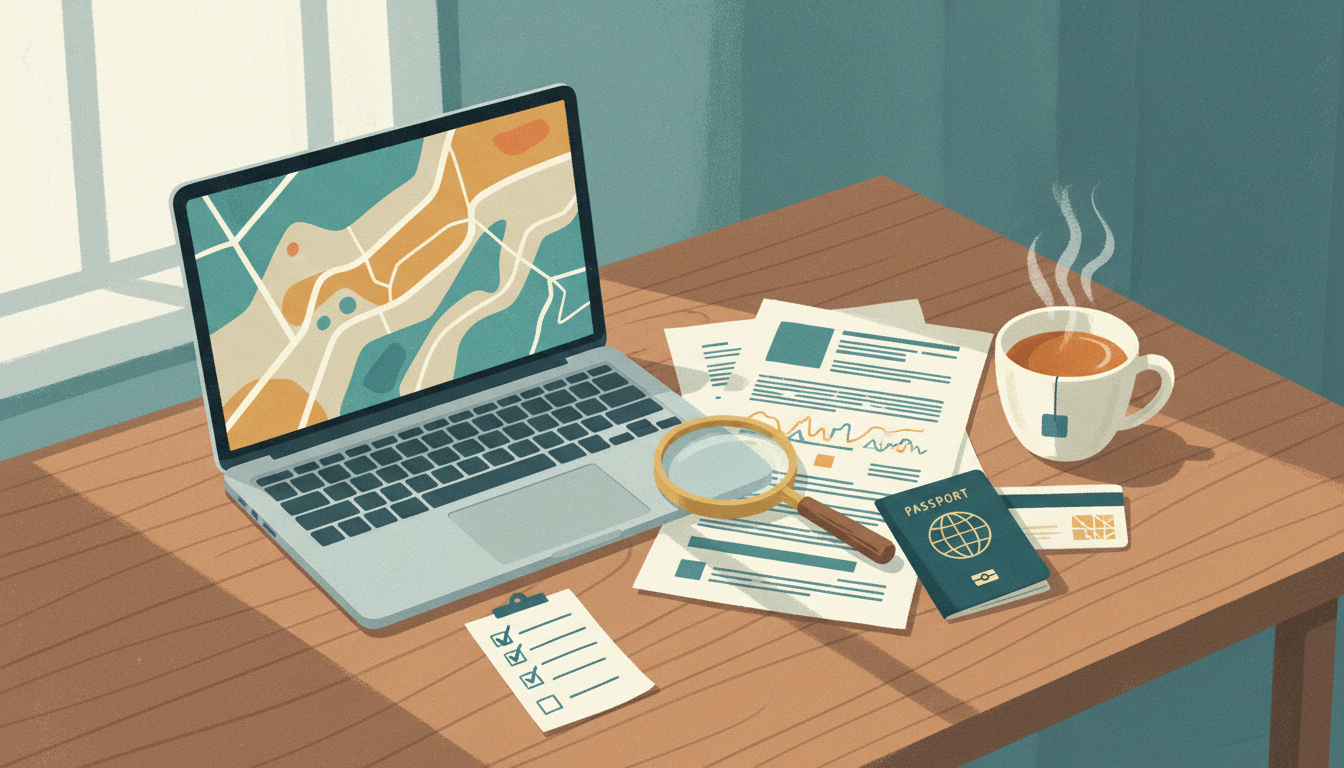
AI tools are brilliant at sounding sure, and that is exactly the problem. The same chatbot that drafts a tidy literature review can invent a journal article that never existed. The same trip planner that promises a “step-free, accessible” hotel may be guessing from a marketing page.
Whether you are writing a research-backed article or booking a room that has to work for your access needs, the fix is the same: treat AI output as a draft, then verify it with the right tools and with the people who can actually confirm the facts. This guide covers the best AI output verification tools for research and writing, then shows how to use the same habits before booking for accessibility needs.
Quick Takeaways
- AI can produce citations and travel details that look real but are not. Check the source before you rely on it.
- Use layers: a reference checker for existence, a citation tool for context and retractions, and a fact-check search for public claims.
- For travel, replace vague words like “accessible” with measurements and written confirmation from the property.
- Verification takes minutes. A fake citation or the wrong room can cost you far more.
Why AI Output Needs Checking Before You Act on It
Language models predict plausible text. Unless they are built to look things up, they are not retrieving facts, and even tools that do search can misread what they find. Researchers keep documenting the effect. A 2026 study of top-tier conference papers found that reference-level error rates are usually below 1%, yet roughly one in twenty NeurIPS and USENIX Security papers from 2025 still contained at least two likely hallucinated references (Phantom References study). If peer review misses those, a solo writer or traveler should not assume a chatbot got it right.
Travel has its own version of the problem. “Accessible” is not a standardized term. It can mean a properly adapted room with a roll-in shower, or a standard room with a single grab bar. An AI summary that blends listing text, reviews and guesswork will not tell you which one you are getting. Verification matters most where a wrong answer has physical consequences.
The Verification Toolkit for Research and Writing
No single tool catches everything. Think in layers: does the source exist, does it say what the AI claims, is it still valid, and does the wider evidence agree? Features and pricing change often, so check each tool’s site for current details.
| Tool | What it helps you verify | Watch out for |
|---|---|---|
| CheckIfExist (open-source) | Whether a reference exists, matched against CrossRef, Semantic Scholar and OpenAlex | Confirms existence, not that the paper supports your claim |
| scite Reference Check | How each reference is cited by others, plus flags for retractions, corrections and heavily contrasting citations | Misses references without DOIs, such as news and policy documents; an account may be required |
| Zotero + Retraction Watch | Alerts when a saved or cited paper has been retracted | Only as current as the database; new retractions can lag by weeks |
| Consensus | Evidence-based answers drawn from peer-reviewed papers, with links to the studies | Academic literature only; treat summaries as a lead, not proof |
| Elicit | Structured tables of findings extracted from papers, with source citations | Can miss relevant studies; use as a second check, not a full search |
| Google Fact Check Explorer | Whether fact-checking organizations have already rated a public claim | No result does not mean a claim is true |
Check That the Reference Actually Exists
Start with the cheapest test. Paste the DOI into doi.org, or search the exact title on Google Scholar or Semantic Scholar. For a whole bibliography, an open-source checker such as CheckIfExist can batch-check references against several scholarly databases, and the authors of the Phantom References study released an open-source tool called RefChecker for the same job.
If nothing matches, treat the citation as fabricated until proven otherwise. Also watch for half-real references: research on citation verification describes fabricated titles, wrong authors, mismatched venues and invalid identifiers, often mixed with real details.
Check That the Source Supports the Claim
A real paper can still be cited for something it never said. Open it and find the sentence, table or figure behind the claim. For a finished draft, scite‘s Reference Check lets you upload a PDF and see how each reference is used in your text and how other papers have cited it. It flags retractions, corrections and unusually high levels of contrasting citations. It will miss sources without DOIs, such as news articles, so check those by hand.
Check for Retractions and Corrections
Zotero is a free reference manager that warns you when you add or cite a retracted paper, using data from the Retraction Watch database. It is a strong safety net, but librarians note it can only be as current as the database, and some retractions take weeks to appear. For anything high-stakes, search the paper title in Retraction Watch yourself.
Test the Claim Against the Wider Evidence
Consensus and Elicit are AI research assistants that work from academic papers and link back to them, which makes them better starting points than a general chatbot. Independent evaluations have found that AI literature tools can miss many relevant studies compared with a traditional database search, so use them to scope a question and to get a second opinion, not as the final word.
For claims circulating in the news or on social media, search Google Fact Check Explorer. It surfaces fact-checks from participating publishers, with their ratings and links to the full articles. If nothing shows up, that only means nobody has checked it yet.
A Five-Minute Verification Routine
- Mark every AI-supplied fact, number, quote and citation as “unverified”.
- Confirm each reference exists by DOI or exact title.
- Open the source and find the passage that supports the claim.
- Check for retractions, corrections and strong disagreement from other studies.
- Cross-check anything you will publish, pay for or depend on with a second, independent source, and keep a simple source log.

Apply the Same Habits Before Booking for Accessibility Needs
AI trip planners are useful for shortlists, itineraries and drafting questions. They cannot walk through a hotel room. Treat their output the way you treat an unverified citation: a lead to confirm, not a fact to book on.
Replace Vague Words With Measurements
“Accessible room” and “ADA-compliant” do not answer practical questions. Ask for specifics that match your own needs:
- Clear width of the room door and bathroom door, measured with the door open
- Roll-in (step-free) shower, or a tub or curbed shower, and whether the seat is fixed or a loose bench
- Bed height and clear floor space on each side
- Whether grab bars are permanent
- A step-free route from the entrance to the room, including lift size
- Photos or video of the exact room type, including the full bathroom
Many access guides cite roughly 80 cm (32 in) as a minimum clear door width for a manual wheelchair and more for powered chairs. Compare numbers against your own equipment rather than a generic standard.

Cross-Check What the AI Told You
- Wheelmap: a free, crowdsourced map that rates places with a traffic-light system (green, orange, red). Crowdsourced data can be outdated or missing, so use it as one signal.
- AccessAble: publishes Detailed Access Guides built from facts, figures and photographs. Coverage varies by country, so check whether your destination is included.
- Recent guest reviews and listing Q&A: look for specific mentions of step-free entry, shower type and lift size, not general praise.
- The property itself: call or email. Email gives you a written record, which helps if the room does not match.
A Message You Can Send Before Booking
Ask your AI assistant to tailor this to your trip, but remember that the answers must come from the property, not the chatbot.
Hello, I am planning to book [room type] for [dates]. Before I confirm, could you please confirm in writing: (1) the clear width of the room door and the bathroom door, (2) whether the shower is step-free with no lip, and whether it has a fixed seat, (3) the bed height, (4) whether the grab bars are permanently fixed, and (5) the step-free route from the entrance to the room. Photos of the bathroom would also help. Please note my requirements on the reservation. Thank you.

3 Common Mistakes
1. Treating AI Confidence as Evidence
A specific-sounding answer, such as an author, a year, a door width or a “roll-in shower” claim, feels trustworthy because it is detailed. Detail is not proof. Fix: ask where each fact came from, then open that source yourself.
2. Checking That a Source Exists but Not What It Says
The same slip happens in travel: confirming that a hotel has accessible rooms, but not that the specific room type you are booking has the feature you need. Fix: verify the claim at the level you will rely on, meaning the passage in the paper or the exact room type on your reservation.
3. Accepting Vague or Verbal-Only Answers
“It meets standards” or “it should be fine” does not answer a measurement question, and a verbal promise is hard to prove later. Fix: ask for numbers, get the confirmation in writing, ask the property to note your needs on the booking, and re-confirm a few days before you travel.
Short FAQ
Can I trust AI tools that show citations?
Not automatically. A citation can be real but not support the claim, or look real and not exist. Open the source before you rely on it.
Is there a free way to check if a reference is real?
Yes. Search the DOI or exact title in Google Scholar or Semantic Scholar, or try an open-source checker such as CheckIfExist for a whole list.
Can AI still help with accessible trip planning?
Yes, for shortlists, itinerary drafts and question lists. It cannot confirm real room features, so the property must confirm every detail you depend on.
Do I need to verify everything AI writes?
Prioritize anything you will publish, cite, pay for or depend on physically. Low-stakes brainstorming does not need the full routine.
Conclusion
AI makes research, writing and trip planning faster, but speed is only useful when the output is right. The habit that protects you is simple: draft with AI, then verify with evidence. Use a reference checker for existence, a citation tool for context and retractions, a fact-check search for public claims, and independent sources plus written confirmation before you book for accessibility needs.
Pick one tool and one checklist from this guide and use them on your next AI-assisted draft or booking. That small step turns AI from a confident guesser into a genuinely useful assistant. Travel far, work smart, and verify before you trust.



Leave a Reply