Here’s a powerful quote by the philosopher Simone de Beauvoir that fits beautifully with the dinner idea:
“I wish that every human life might be pure transparent freedom.” [1]
And here’s another widely cherished one:
“One’s life has value so long as one attributes value to the life of others, by means of love, friendship, indignation and compassion.”
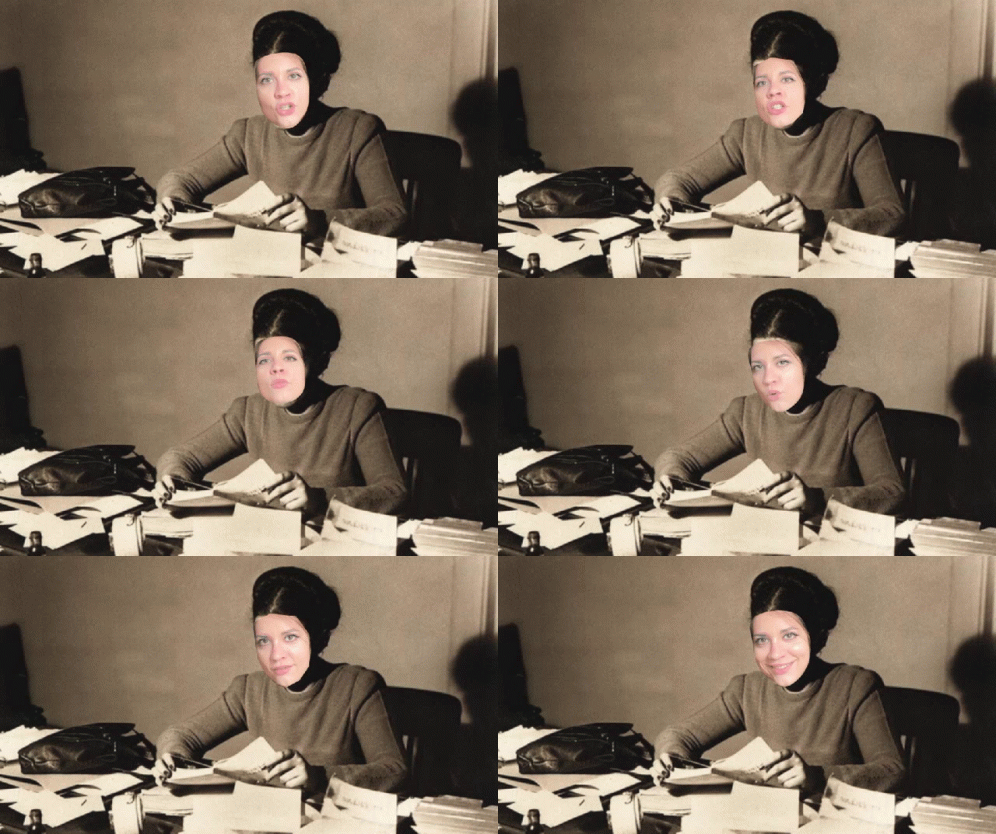
I love this prompt — it’s the sort of imaginative question that turns thinking into a party. If I could have dinner with any philosopher, I’d pick Simone de Beauvoir. She combined fierce intellect, emotional honesty, and an appetite for life that would make for an electric evening.
If you could sit down for dinner with any philosopher, who would you choose? I’d pick Simone de Beauvoir — and not just because she wrote brilliantly about freedom and responsibility, but because she felt like someone who’d order the spiciest thing on the menu and insist we talk until the kitchen closed.

Imagine arriving at a cozy bistro: warm light, clinking glasses, the faint rustle of a city that’s always in motion. She’s already there, with the casual confidence of someone who knows how to live deliberately. Conversation with Beauvoir wouldn’t be an abstract lecture; it would be an invitation to look at life differently. She’d ask what you do each morning, why you choose the things you choose, and whether your relationships expand or shrink your sense of possibility.

What makes Beauvoir such a compelling dinner companion is how she blended rigorous thought with lived experience. She didn’t confine philosophy to armchairs and journals. Her questions were about the nitty-gritty: how social expectations shape our choices, how we make meaning in ordinary routines, how love can be both liberation and cage. Over a shared plate, she’d probably interrupt me with a sharp anecdote about an encounter that reframed her ideas, then circle back to a philosophical point with the kind of clarity that makes complex things feel suddenly visible.

I’d want to talk about freedom — not as a lofty ideal but as the everyday practice of choosing and owning those choices. Would she advise radical independence, or a kind of negotiated interdependence? She’d likely remind me that freedom always comes with responsibility: to ourselves, to others, and to the future we shape. That balance between autonomy and care is something she explored with both intellectual rigor and human empathy.
And the dinner would be sprinkled with humor. Beauvoir had a wry, candid voice; she could be cutting when she needed to be, tender when the moment called for it. I’d ask about her partnership with Jean-Paul Sartre — not for gossip, but to understand how two strong thinkers can influence each other without losing themselves. I’d ask what she read at twenty and at sixty. I’d ask how she handled doubt and failure. Her answers would be honest, maybe unpolished, and all the richer because of it.

By the time dessert arrived, the conversation would probably drift into practicalities: how to mentor younger thinkers, how to act politically without losing one’s ethical compass, how to make small gestures that compound into real change. She’d encourage curiosity, insist on stubborn integrity, and recommend books I’d never heard of.
Leaving the restaurant, I’d feel both challenged and buoyed — the mark of a great evening. A dinner with Simone de Beauvoir wouldn’t just feed the mind; it would recalibrate how you see your life’s possibilities. That’s the kind of conversation that lingers, shaping choices long after the last bite.
 kohsarblog
Leave a comment