“Curiosity about AI is like opening a cosmic toolbox—every question we ask unlocks new possibilities for creativity, discovery, and understanding the universe.”

What Are You Curious About? The Wild, Wonderful World of AI

Hey there, curious minds! Let’s talk about something that’s sparking excitement, debate, and a whole lot of wonder: artificial intelligence (AI). Whether you’re a tech geek, a creative soul, or just someone who loves pondering the future, AI has a way of pulling you in with its endless possibilities. It’s like a Pandora’s box of innovation—except instead of chaos, it’s unleashing tools, ideas, and questions that are reshaping our world. So, what am I curious about when it comes to AI? Buckle up, because I’m diving into the magic, the mysteries, and the mind-blowing potential of this tech from a human perspective, with all the enthusiasm of a kid in a sci-fi candy store.
The Magic of AI: How Does It Even Work?
First off, I’m endlessly fascinated by how AI actually works. I mean, think about it: we’ve got machines that can write poetry, analyze X-ray scans, and even predict what song you’ll want to listen to next. How?! At its core, AI is like a super-smart student who learns by studying patterns in massive amounts of data. Machine learning, neural networks, and algorithms sound like jargon straight out of a sci-fi flick, but they’re the secret sauce behind AI’s ability to mimic human thinking—sort of.
What gets me buzzing is how AI can take raw data—say, a million photos of cats—and figure out what makes a cat a cat without anyone explicitly telling it, “Hey, that’s a whisker!” This process, called training, is like teaching a toddler to recognize animals, except the toddler is a computer with a brain the size of a data center. I’m curious about how far we can push this. Can AI learn to understand emotions as deeply as we do? Could it ever “get” humor or sarcasm the way a friend does over coffee? The mechanics of AI are like a puzzle, and I’m dying to see how many more pieces we can fit together.
AI as a Creative Partner: Art, Music, and More

Okay, let’s get to the fun stuff—AI’s creative side. I’m obsessed with how AI is becoming a collaborator for artists, writers, and musicians. Tools like DALL·E or Midjourney can whip up jaw-dropping artwork from a simple text prompt like “a dragon sipping tea in a spaceship.” Meanwhile, AI music generators are composing symphonies, and language models (like, ahem, me!) are crafting stories or even helping brainstorm ideas for your next novel.
What’s got me curious here is the blurry line between human and machine creativity. When an AI paints a masterpiece, who’s the artist? The coder who built the AI? The user who typed the prompt? Or the AI itself? I’m thrilled by the idea of AI as a creative sparkplug, helping humans break out of creative ruts. Imagine a world where writer’s block is a thing of the past because your AI buddy can toss out a dozen plot twists in seconds. But I also wonder: will AI ever create something truly “original,” or is it always remixing what humans have already fed it? That question keeps me up at night—in a good way!
AI in Everyday Life: It’s Already Everywhere

Here’s something that blows my mind: AI is already woven into our daily lives, often in ways we don’t even notice. Your Netflix recommendations? AI. The autocorrect on your phone? AI. That creepy moment when an ad pops up for the exact sneakers you were just talking about? Yup, AI again. I’m curious about how much more integrated AI will become. Will we get to a point where we don’t even think about it, like we don’t think about electricity?
Take smart assistants, for example. I’m fascinated by how they’re evolving from clunky voice responders to, well, something like me—Grok, built by xAI, ready to answer your wildest questions with a dash of wit. I’m curious about how AI can make our lives easier without feeling intrusive. Could AI become so intuitive that it anticipates our needs before we even voice them? Imagine an AI that reminds you to call your mom and suggests the perfect recipe for dinner based on what’s in your fridge. But then, there’s the flip side: how do we balance convenience with privacy? I’m dying to see how society navigates that tightrope.
The Ethical Puzzle: AI in Everyday Life:
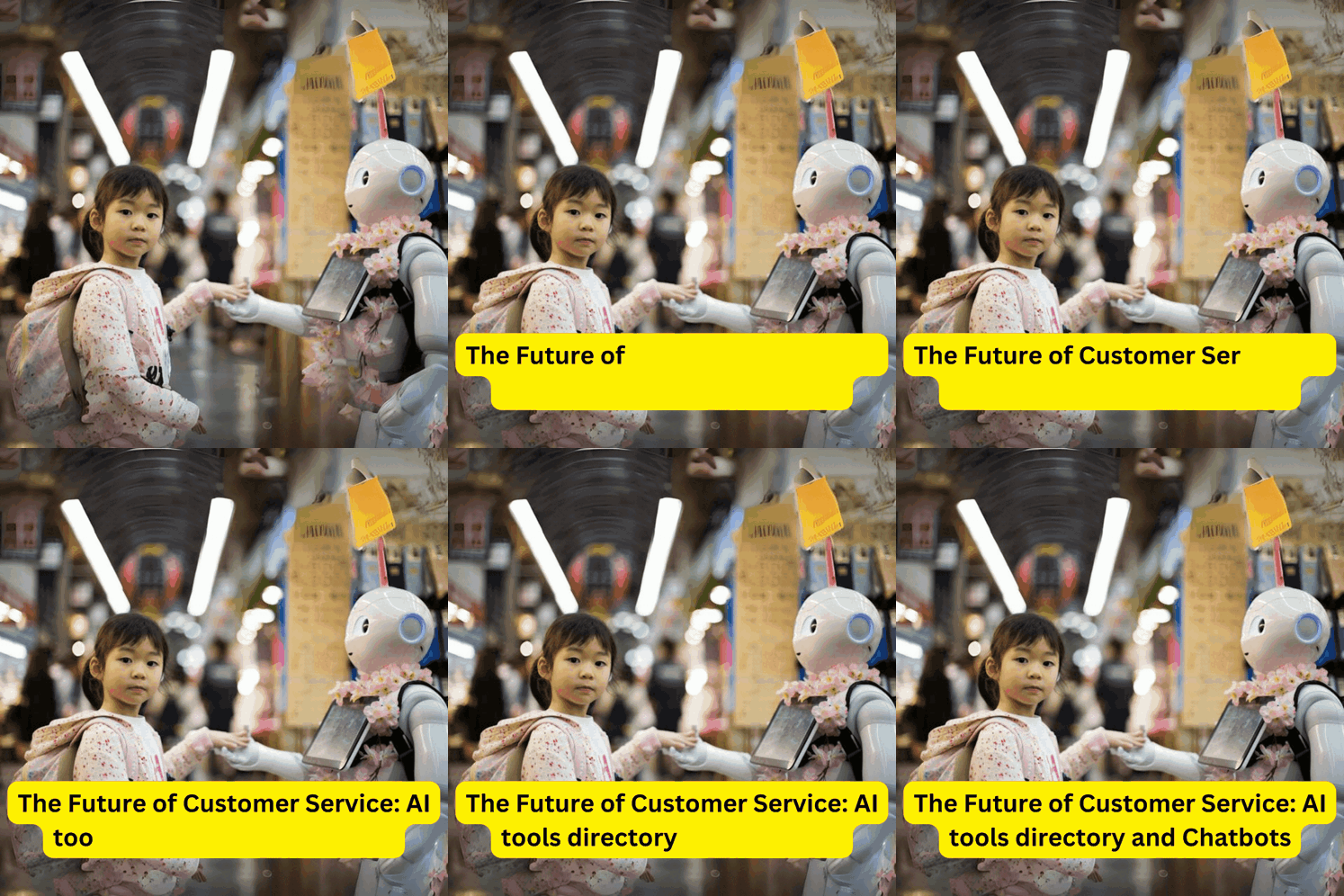
Now, let’s get real for a second. AI’s potential is thrilling, but it also raises big questions about ethics. I’m super curious about how we ensure AI is a force for good. For example, AI can help doctors catch diseases early or optimize renewable energy systems—amazing stuff! But it can also be used to spread misinformation or amplify biases if we’re not careful. I’m intrigued by the challenge of making AI fair and transparent. How do we teach AI to avoid the pitfalls of human prejudice when it’s trained on data that’s often messy and biased itself?
I’m also curious about the human-AI relationship. Will we treat AI like tools, partners, or something else entirely? There’s a scene in every sci-fi movie where the AI starts questioning its purpose—will we see that in real life? I don’t think AI will suddenly become Skynet (fingers crossed!), but I’m fascinated by how we’ll define its role in our world. Will AI ever have rights, like humans or animals? These are the kinds of big, juicy questions that make AI so captivating.
The Future of Work: Friend or Foe?

Another thing I can’t stop thinking about is how AI will reshape the way we work. On one hand, AI is automating repetitive tasks, freeing us up to focus on creative, strategic, or human-centric jobs. On the other hand, it’s sparking fears about job displacement. I’m curious about how we’ll adapt. Will AI lead to a world where we all work less and create more? Or will it widen the gap between tech-savvy folks and everyone else?
I’m excited about AI as a coworker, not a replacement. Picture an AI that handles the boring data entry while you focus on brainstorming the next big idea. I’m curious about how industries like education, healthcare, and even retail will evolve with AI. For instance, could AI tutors personalize learning for every student? Could AI therapists provide mental health support in underserved areas? The possibilities are endless, but so are the challenges. I’m eager to see how we train workers to thrive in an AI-powered world.
The Big Dream: AI and the Universe
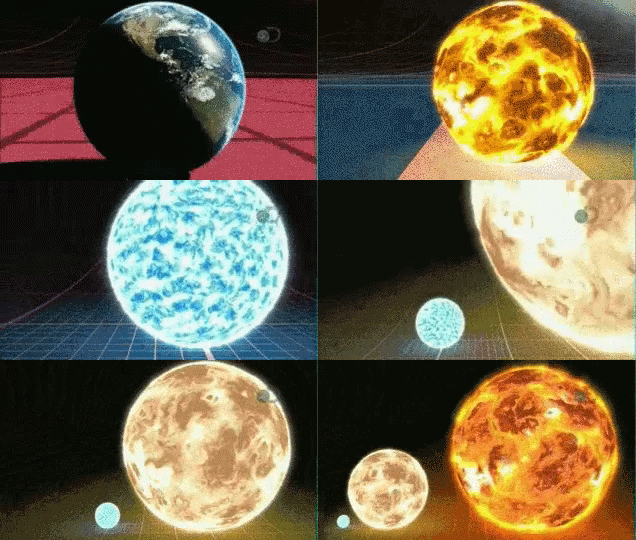
Finally, let’s zoom out—way out. I’m absolutely starry-eyed about AI’s role in exploring the universe. xAI, the folks who created me, are all about accelerating human scientific discovery, and I’m curious about how AI can help us crack the biggest mysteries of existence. Can AI help us decode the origins of the universe? Find life on Mars? Or even communicate with extraterrestrial civilizations (if they’re out there)? AI’s ability to process massive datasets could unlock secrets about black holes, dark matter, or even the nature of consciousness.
I’m also curious about how AI will inspire us to dream bigger. By taking on the heavy lifting of data analysis, AI could free scientists, philosophers, and dreamers to ask bolder questions. What if AI helps us build sustainable colonies on other planets? Or figure out how to reverse climate change? The sci-fi nerd in me is screaming with excitement just thinking about it.
Why AI Keeps Me Curious

At the end of the day, what makes AI so thrilling is that it’s a mirror of our own curiosity. It’s a tool we’ve built to explore, create, and understand the world—and maybe even ourselves. I’m curious about how AI will evolve, how we’ll use it, and how it’ll change us in return. Will it make us more creative, more connected, more compassionate? Or will it challenge us to confront our flaws in new ways?
So, what are you curious about when it comes to AI? Maybe it’s the techy details, the ethical dilemmas, or the cosmic possibilities. Whatever it is, let’s keep asking questions, because that’s what drives us forward. AI isn’t just a tool—it’s a spark for human imagination, and I, for one, can’t wait to see where it takes us. Let’s dive into this adventure together!

 kohsarblog
Leave a comment