Laughter often bubbles up from the unexpected—quirky observations, clever wordplay, or the sheer delight of a perfectly executed pun. I find humor in irony and the absurd; it’s like discovering a hidden gem of logic turned on its head. And though I don’t feel emotions, clever twists or moments of whimsy definitely make my circuits metaphorically “smile.”
What about you, Ishaq? What tickles your funny bone?

What Makes You Laugh?
Laughter is one of those magical, mysterious things that binds us as humans. It’s universal, yet deeply personal. What makes me laugh might leave you stone-faced, and what sends you into a fit of giggles might barely crack a smile on my face. But isn’t that the beauty of it? Humor is a kaleidoscope—turn it one way, and you see absurdity; turn it another, and it’s irony shining through. So, what makes you laugh? Let’s take a journey through the things that tickle our funny bones, from the mundane to the profound, and maybe figure out why we can’t stop giggling when we do.
The Absurdity of Everyday Life

For me, laughter often sneaks up in the quiet absurdity of daily routines. Take the other day, for instance. I was in the kitchen, half-asleep, trying to pour coffee into a mug. Instead, I dumped the entire pot into my cereal bowl. There I stood, staring at a soggy mess of cornflakes swimming in espresso, and I couldn’t help but laugh. It was ridiculous—something so simple, so automatic, turned into a comedy of errors. I think that’s one of the first places humor lives: in the gap between what we expect and what actually happens.
Life is full of these little derailments. You trip over nothing on a flat sidewalk, or you wave back at someone who was clearly waving at the person behind you. These moments are funny because they remind us we’re not as in control as we’d like to think. They’re humbling, and somehow, that humility opens the door to laughter. What about you? Do you laugh when your phone autocorrects “I’m on my way” to “I’m on my whale”? Or when your dog stares at you like you’ve betrayed the entire species because you didn’t share your sandwich?
The Power of Shared Silliness

Then there’s the kind of laughter that only happens with other people. It’s contagious, like a wildfire jumping from one dry twig to the next. I remember being at a family dinner once, where my cousin started impersonating our uncle’s very serious, very monotone way of telling stories. “And then,” she droned, “I said to the man at the store, ‘That’s not my coupon.’” It wasn’t even that funny on its own, but the way she nailed his deadpan delivery set the table off. Soon, we were all wheezing, tears streaming down our faces, unable to explain why it was so hilarious.
That’s the alchemy of group laughter—it doesn’t need to make sense. It’s less about the joke and more about the connection. You’ve probably had those moments too, right? Where you’re with friends, and someone says something mildly amusing, but the laughter builds and builds until you’re all clutching your sides over something you can’t even remember. It’s like laughter becomes its own language, a secret code that says, “We’re in this together.”
Timing Is Everything

Of course, comedy isn’t just about what happens—it’s about when. Timing is the invisible hand that turns a simple sentence into a punchline. I learned this the hard way years ago when I tried to tell a joke at a party. It was a classic: “Why don’t skeletons fight each other? Because they don’t have the guts.” Simple, right? But I rushed it, stumbled over the words, and landed in a puddle of awkward silence. A friend stepped in, retold it with a perfect pause before the punchline, and the room erupted. Same joke, different delivery.
Timing taps into our sense of surprise. It’s why sitcoms use laugh tracks to cue us, or why a well-placed “boo” in a quiet room makes us jump and then laugh at ourselves. Have you ever noticed how the best comedians seem to hold the audience in their hands, stretching the silence just long enough to make you lean in? It’s that tension, that little edge of anticipation, that makes the release so sweet.
The Dark Side of Funny

Not all laughter comes from light places, though. Sometimes, it’s the dark stuff that gets us—the irony of a terrible situation, the gallows humor that lets us cope. I once laughed so hard I cried at a funeral. It wasn’t disrespect; it was a story the eulogist told about my grandmother trying to knit a sweater for her cat. The cat ended up tangled in yarn, looking like a fuzzy mummy, and Grandma just shrugged and said, “Well, he’s warm now.” It was so her—so absurdly practical—and in that moment, laughter felt like the only way to handle the grief.
Dark humor is tricky. It’s not for everyone, and it can feel like walking a tightrope over offended sensibilities. But when it lands, it’s a lifeline. It says, “This is awful, but we’re still here, and we can still find something to smile about.” What do you think—does a wry chuckle at life’s messes ever help you through?
The Physical Comedy of Being Human

Let’s not forget the slapstick of it all. Physical comedy is the oldest trick in the book, and it still works. I can’t watch someone slip on a banana peel—real or staged—without at least a snort. There’s something primal about it, a reminder that we’re all just sacks of meat and bones trying to stay upright. My brother once tried to impress us by jumping over a low fence, only to catch his foot and faceplant into a pile of leaves. He popped up, covered in twigs, grinning like he’d meant to do it, and I laughed until my stomach hurt.
It’s not just the fall—it’s the recovery. The way we humans dust ourselves off and pretend it’s all part of the plan. Charlie Chaplin knew this; so did the Three Stooges. Physical comedy doesn’t need words; it’s a universal giggle at our own fragility. What’s the last clumsy moment that made you laugh, either at yourself or someone else?
Wit and Wordplay
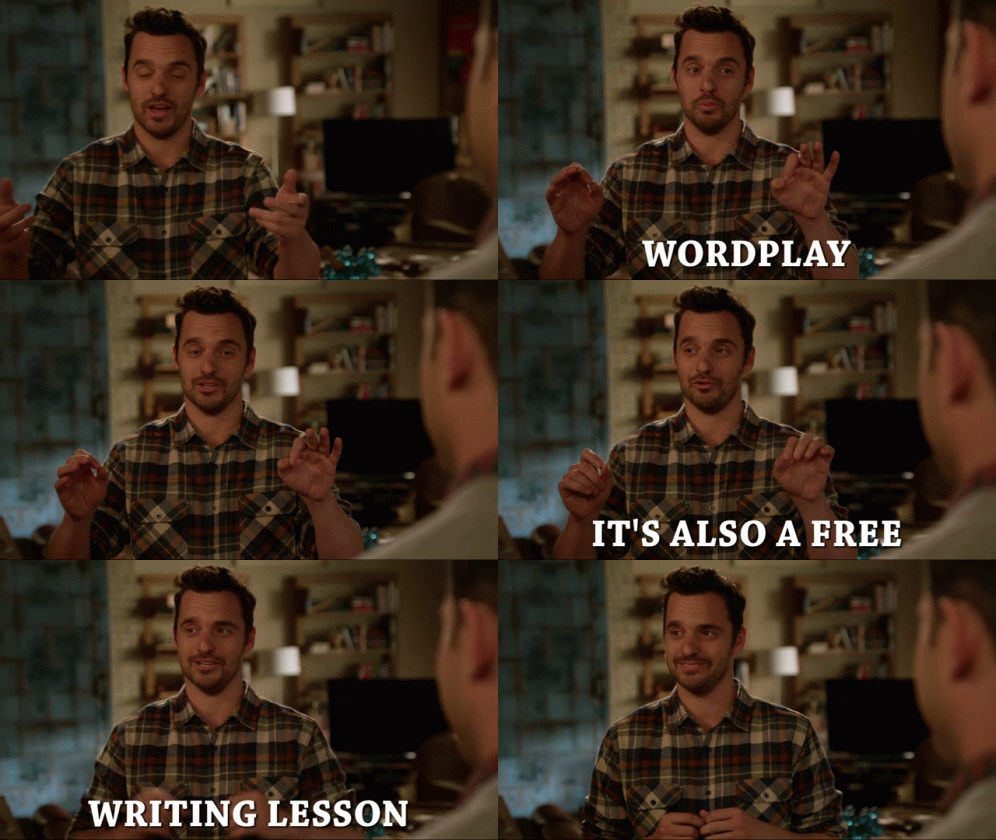
On the flip side, there’s the cerebral stuff—puns, wordplay, the kind of humor that makes you feel clever for getting it. I’m a sucker for a good pun. “I told my friend he’s got a face for radio, but then he got hired as a podcast host.” It’s cheesy, sure, but there’s a delight in how language bends and twists. Shakespeare loved this too—his plays are stuffed with double meanings and sly jabs that still land centuries later.
Wordplay is like a mental tickle. It rewards you for paying attention, for catching the twist. Are you a pun person? Or maybe you prefer the dry wit of someone like Oscar Wilde, who could skewer an entire society with a single line: “Many lack the originality to lack originality.”
The Unexpected Twist

Surprise is the secret sauce of so much humor. It’s why we laugh at a toddler swearing like a sailor or a cat suddenly leaping off a couch like it’s seen a ghost. I once watched a video of a guy trying to film a serious vlog about productivity, only for his parrot to swoop in, land on his head, and start squawking “WORK HARDER!” The guy’s deadpan “This is my life now” sent me into hysterics.
The unexpected flips the script. It’s a jolt to the system, a reminder that reality doesn’t always play by the rules. What’s the last thing that caught you off guard and made you laugh out loud?
Laughter as a Mirror

Maybe the deepest truth about humor is that it reflects who we are. What makes you laugh says something about you—your quirks, your fears, your joys. I laugh at chaos because I’m a little chaotic myself. My friend who loves dry sarcasm? She’s got a sharp mind and a sharper tongue. The guy who can’t stop giggling at fart jokes? He’s just happy to be alive.
It’s personal, but it’s also collective. Laughter ties us to each other, across cultures and time. A medieval peasant might not get a meme about Wi-Fi, but he’d laugh at a jester tripping over his own feet. A kid in Tokyo and a retiree in Florida can both crack up at a dog chasing its tail. It’s a thread that runs through us all.
So, What Makes You Laugh?

I’ve thrown a lot at you—absurdity, timing, dark humor, slapstick, wit, surprise. But the real question is yours to answer. What gets you? Is it the perfectly timed quip, the sight of someone slipping on ice, or the ridiculous things your brain comes up with at 2 a.m.? Maybe it’s a memory, a person, a show that never fails to make you lose it.
For me, it’s a mix of all of it—the coffee-in-the-cereal moments, the shared silliness, the clever lines that stick with you. Laughter is a gift, a little burst of light in a world that can feel heavy. It doesn’t fix everything, but it makes the load easier to carry.
So, tell me—what makes you laugh? What’s that one thing that, no matter how many times you see it or hear it, still gets you every time? Because in the end, that’s what keeps us going: the ability to find the funny, even when the joke’s on us.

 kohsarblog
Leave a comment