Here’s a thought-provoking quote about AI:
“The real question is, when will we draft an artificial intelligence bill of rights? What will that consist of? And who will get to decide that?”
—Gray Scott
AI has the potential to reshape our future in many ways. What are your thoughts on its impact?
The Most Important Invention in My Lifetime: Artificial Intelligence (AI)
In the span of a single lifetime, humanity has witnessed an unprecedented acceleration in technological advancements. From the advent of the internet to the proliferation of smartphones, each innovation has reshaped the way we live, work, and interact with the world. However, among these groundbreaking developments, one stands out as the most transformative: Artificial Intelligence (AI). AI is not just a tool or a gadget; it is a paradigm shift that is redefining the very fabric of society. In this blog post, I will explore why AI is the most important invention in my lifetime, delving into its impact on various sectors, its potential for future growth, and the ethical considerations it brings to the forefront.
The Genesis of AI: From Concept to Reality

Artificial Intelligence, as a concept, has been around for decades. The term itself was coined in 1956 by John McCarthy at the Dartmouth Conference, where the foundational ideas of AI were first discussed. However, it wasn’t until the 21st century that AI began to move from theoretical constructs to practical applications. The convergence of big data, advanced algorithms, and powerful computing hardware has propelled AI from the realm of science fiction into our everyday lives.
In the early 2000s, AI was primarily associated with academic research and niche applications. However, the last two decades have seen exponential growth in AI capabilities, driven by advancements in machine learning, neural networks, and deep learning. Today, AI is embedded in everything from voice assistants like Siri and Alexa to recommendation algorithms on Netflix and Amazon. It powers autonomous vehicles, medical diagnostics, financial trading, and even creative processes like music composition and art generation.
AI in Everyday Life: The Invisible Revolution
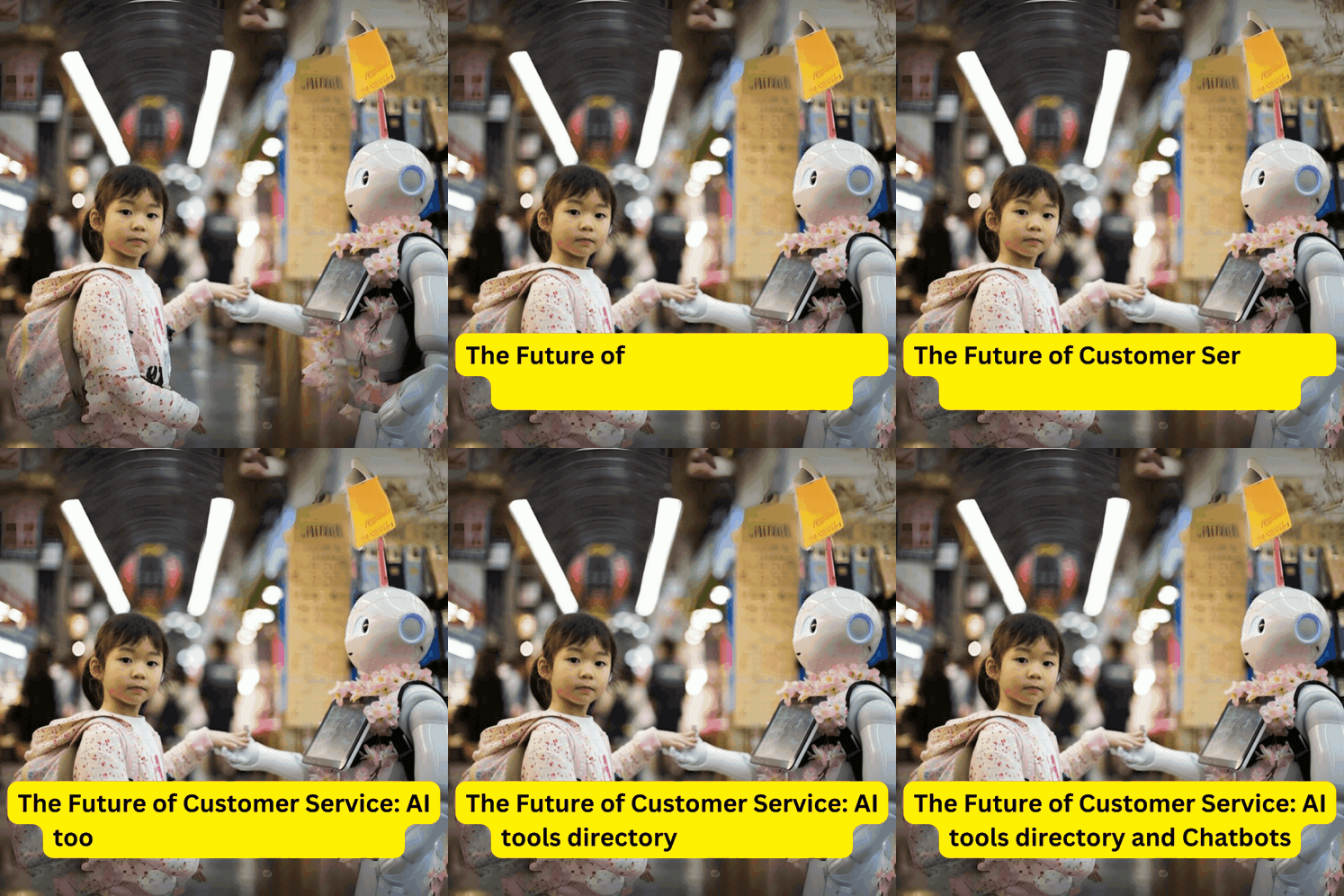
One of the most remarkable aspects of AI is its ubiquity. Unlike previous technological revolutions that required significant changes in infrastructure or behavior, AI has seamlessly integrated into our daily lives. It operates quietly in the background, enhancing our experiences and making our lives more convenient.
Consider the smartphone, a device that has become an extension of ourselves. AI is at the heart of its functionality, from facial recognition and voice commands to predictive text and personalized recommendations. AI-driven apps help us navigate traffic, track our fitness, and even manage our mental health. The convenience and efficiency that AI brings to our daily routines are unparalleled.
Moreover, AI has revolutionized the way we consume information. Search engines like Google use AI algorithms to deliver relevant results in milliseconds. Social media platforms employ AI to curate our news feeds, ensuring that we see content that aligns with our interests. While this has raised concerns about echo chambers and filter bubbles, there’s no denying that AI has made information more accessible than ever before.
AI in Healthcare: Saving Lives and Transforming Medicine2

Perhaps the most profound impact of AI can be seen in the field of healthcare. AI is revolutionizing medicine by enabling earlier diagnosis, personalized treatment, and more efficient healthcare delivery. Machine learning algorithms can analyze vast amounts of medical data, identifying patterns and correlations that would be impossible for humans to detect.
For instance, AI-powered imaging systems can detect early signs of diseases like cancer with remarkable accuracy. These systems can analyze medical images, such as X-rays and MRIs, and flag abnormalities that might be missed by human radiologists. This not only improves diagnostic accuracy but also reduces the time and cost associated with traditional diagnostic methods.
AI is also playing a crucial role in drug discovery and development. Traditional drug discovery is a time-consuming and expensive process, often taking years and billions of dollars to bring a new drug to market. AI algorithms can analyze biological data and predict how different compounds will interact with targets in the body, significantly speeding up the discovery process. This has the potential to bring life-saving treatments to patients faster and at a lower cost.
In addition to diagnostics and drug discovery, AI is transforming patient care. Virtual health assistants powered by AI can provide personalized health advice, remind patients to take their medications, and even monitor vital signs in real-time. This is particularly beneficial for managing chronic conditions and providing care to elderly patients, who may require continuous monitoring.
AI in Business: Driving Efficiency and Innovation

The business world has also been profoundly impacted by AI. Companies across industries are leveraging AI to optimize operations, enhance customer experiences, and drive innovation. In the realm of customer service, AI-powered chatbots and virtual assistants are handling routine inquiries, freeing up human agents to focus on more complex issues. These AI systems can provide instant responses, operate 24/7, and learn from interactions to improve over time.
AI is also transforming supply chain management. Predictive analytics powered by AI can forecast demand, optimize inventory levels, and identify potential disruptions in the supply chain. This enables companies to make data-driven decisions, reduce costs, and improve efficiency. For example, retail giants like Amazon use AI to manage their vast logistics networks, ensuring that products are delivered to customers as quickly as possible.
In the financial sector, AI is revolutionizing everything from fraud detection to investment strategies. Machine learning algorithms can analyze transaction data in real-time, identifying suspicious patterns that may indicate fraudulent activity. This not only protects consumers but also saves financial institutions billions of dollars annually. AI is also being used to develop sophisticated trading algorithms that can analyze market trends and execute trades at lightning speed, often outperforming human traders.
AI in Education: Personalizing Learning and Expanding Access

Education is another area where AI is making a significant impact. Traditional education systems often struggle to cater to the diverse needs of students, leading to disparities in learning outcomes. AI has the potential to address these challenges by personalizing the learning experience for each student.
Adaptive learning platforms powered by AI can assess a student’s strengths and weaknesses, tailoring content to their individual needs. These platforms can provide real-time feedback, suggest additional resources, and adjust the difficulty level of exercises based on the student’s performance. This not only enhances learning outcomes but also keeps students engaged and motivated.
AI is also expanding access to education, particularly in underserved regions. Online learning platforms powered by AI can deliver high-quality education to students in remote areas, breaking down geographical barriers. Moreover, AI-driven language translation tools are making it easier for students to access educational content in their native languages, further democratizing education.
AI Creativity: Redefining Art in and Innovation
One of the most surprising and exciting developments in AI is its foray into the realm of creativity. Historically, creativity was considered a uniquely human trait, but AI is challenging this notion. AI algorithms are now capable of composing music, generating art, and even writing poetry.
For example, AI-powered tools like OpenAI’s GPT-3 can generate coherent and contextually relevant text, enabling applications ranging from content creation to code generation. Similarly, AI algorithms like DeepArt and DALL-E can create stunning visual art, often indistinguishable from works created by human artists. These tools are not replacing human creativity but rather augmenting it, providing new avenues for artistic expression and innovation.
In the field of design, AI is being used to generate innovative solutions to complex problems. For instance, AI algorithms can optimize the design of products, buildings, and even urban spaces, taking into account factors like functionality, sustainability, and aesthetics. This has the potential to revolutionize industries like architecture, engineering, and product design.
The Ethical Implications of AI: Navigating the Challenges

While the benefits of AI are undeniable, it also raises important ethical questions that society must address. One of the most pressing concerns is the potential for bias in AI algorithms. AI systems are only as good as the data they are trained on, and if that data contains biases, the AI will perpetuate and even amplify those biases. This can lead to unfair outcomes in areas like hiring, lending, and law enforcement.
For example, AI-powered hiring tools have been found to favor certain demographics over others, perpetuating existing inequalities. Similarly, predictive policing algorithms have been criticized for targeting minority communities, leading to concerns about racial profiling. Addressing these issues requires a concerted effort to ensure that AI systems are trained on diverse and representative data, and that they are regularly audited for bias.
Another ethical concern is the impact of AI on employment. As AI systems become more capable, there is a growing fear that they will displace human workers, particularly in industries like manufacturing, retail, and transportation. While AI has the potential to create new jobs and industries, the transition may be painful for those whose skills are rendered obsolete. Policymakers, educators, and businesses must work together to ensure that workers are equipped with the skills needed to thrive in an AI-driven economy.
Privacy is another major concern in the age of AI. AI systems often rely on vast amounts of personal data to function effectively, raising questions about how that data is collected, stored, and used. There is a risk that AI could be used to surveil individuals, eroding privacy and civil liberties. Striking the right balance between leveraging data for AI advancements and protecting individual privacy is a complex challenge that requires robust regulatory frameworks.
The Future of AI: Opportunities and Challenges Ahead
As we look to the future, the potential of AI is both exciting and daunting. On one hand, AI has the potential to solve some of the world’s most pressing problems, from climate change to healthcare. On the other hand, it poses significant risks if not managed responsibly.
One of the most promising areas of AI research is in the field of artificial general intelligence (AGI), which refers to AI systems that possess the ability to understand, learn, and apply knowledge across a wide range of tasks, much like a human. While AGI is still in its infancy, its development could lead to breakthroughs in fields like science, medicine, and engineering. However, it also raises existential questions about the role of AI in society and the potential for AI to surpass human intelligence.
Another area of focus is the development of AI that is aligned with human values and ethics. As AI systems become more autonomous, it is crucial that they are designed to prioritize human well-being and adhere to ethical principles. This requires interdisciplinary collaboration between AI researchers, ethicists, policymakers, and other stakeholders to ensure that AI is developed and deployed in a way that benefits humanity as a whole.
Conclusion: AI as the Defining Invention of Our Time

In conclusion, Artificial Intelligence is the most important invention of my lifetime, not only because of its transformative impact on various sectors but also because of its potential to shape the future of humanity. AI has already revolutionized the way we live, work, and interact with the world, and its influence will only continue to grow in the years to come.
However, with great power comes great responsibility. As we continue to develop and deploy AI, we must be mindful of the ethical implications and ensure that AI is used to enhance human well-being rather than undermine it. By addressing the challenges and harnessing the opportunities that AI presents, we can create a future that is not only technologically advanced but also equitable, sustainable, and just.
AI is not just a tool; it is a reflection of our values, aspirations, and collective potential. As we navigate the complexities of this new era, let us strive to ensure that AI remains a force for good, empowering us to build a better world for generations to come.

 kohsarblog
Leave a comment