Education is not the filling of a pot but the lighting of a fire.” – W.B. Yeats1.
“Teaching is not a lost art, but the regard for it is a lost tradition.” – Jacques Barzun1.
“A teacher is one who makes himself progressively unnecessary.” – Thomas Carruthers1.
“I am not a teacher, but an awakener.” – Robert Frost1.


Title: “The Magic of Great Teachers: Unveiling the Secrets”
Once upon a time, in a bustling school nestled among the rolling hills, there lived a remarkable teacher named Mrs. Eleanor. She wasn’t just any teacher; she was the kind who wove enchantment into her lessons, leaving an indelible mark on her students’ hearts.
🌟 Introduction: The Whispering Oak
In the heart of the schoolyard stood an ancient oak tree. Its gnarled branches reached toward the sky, as if yearning to touch the stars. Legend had it that this tree held the secrets of great teaching—secrets whispered by generations of teachers who sought wisdom beneath its leafy canopy.
One crisp autumn morning, as the leaves danced in golden hues, Mrs. Eleanor gathered her students around the oak. Their eyes sparkled with curiosity. She began her tale:
“Listen closely, my dear ones,” she said, her voice as melodious as a lark’s song. “Great teachers possess magic—a blend of patience, empathy, and wisdom. Let me share their secrets with you.”
🌟 The First Secret: Patience Blooms
“Imagine,” Mrs. Eleanor continued, “a delicate seed planted in fertile soil. It takes time to sprout, to stretch its roots deep into the earth. So it is with teaching. Patience is our soil—the foundation upon which learning flourishes.”
She recounted tales of students who stumbled, who faltered in their understanding. Yet, she patiently watered their minds, allowing ideas to take root. “Patience,” she whispered, “is the key that turns struggle into growth.”
🌟 The Second Secret: Empathy’s Song
“Now,” Mrs. Eleanor leaned in, her eyes kindling with warmth, “imagine a symphony. Each note, each instrument, contributes to the whole. Empathy is our conductor’s baton—it orchestrates harmony.”
She shared stories of children with hidden fears, dreams, and scars. “To teach,” she said, “we must listen—to their laughter, their tears, their unspoken hopes. Empathy bridges the gap between hearts and minds.”
🌟 The Third Secret: Adaptability’s Dance
“Picture a river,” Mrs. Eleanor gestured, “twisting and turning through rugged terrain. Teaching, my darlings, is like dancing with that river. Adaptability is our nimble step—the rhythm that carries us forward.”
She recounted days when lesson plans veered off course, when unexpected storms brewed. “Great teachers,” she mused, “adjust their sails, embrace detours, and find beauty in the unexpected. Adaptability is our compass.”
🌟 The Fourth Secret: Mastery’s Glow
“Finally,” Mrs. Eleanor’s eyes gleamed, “imagine a star-studded sky. Each star—a fragment of knowledge. Great teachers are cosmic explorers, forever seeking to understand. Mastery is our telescope—it reveals wonders beyond the textbooks.”
She spoke of late nights poring over books, of curiosity that burned like a comet’s tail. “To ignite minds,” she said, “we must first ignite our own. Mastery is our celestial fire.”
And so, beneath the whispering oak, Mrs. Eleanor wove her magic. Her students listened, hearts wide open, as if catching stardust.
“Remember,” she concluded, “great teachers are like constellations—they guide, inspire, and illuminate. Now, my dear ones, go forth and be the magic you seek.”
And they did—for the oak had whispered its secrets, and Mrs. Eleanor had sown them into their souls.
🌟 Epilogue: The Legacy
Years later, those students would gather under the same oak, sharing stories of their own classrooms. They’d speak of Mrs. Eleanor—their guiding star—and how her magic had shaped their lives.
And so, the legend continued, carried by the wind, rustling through leaves, and echoing in the hearts of those who dared to teach.
And that, my friends, is the tale of great teachers—their secrets etched in the bark of time.
Sources:
- We Are Teachers (Jill Staake, B.S., Secondary ELA Education)
- GreatSchools.org
- Southern New Hampshire University
- Concordia University Wisconsin
*Image: [Pixabay](https://pixabay.com/photos/oak-tree-tree-oak-forest-nature-1202935
Source: Conversation with Copilot, 6/30/2024
(1) What Makes a Teacher Great?. https://www.youtube.com/watch?v=d70PPcc9690.
(2) What makes a good teacher great? | Azul Terronez | TEDxSantoDomingo. https://www.youtube.com/watch?v=vrU6YJle6Q4.
(3) Top 10 Qualities of a Great Teacher. https://www.youtube.com/watch?v=Pbg1XOI5wM0.
(4) 10 Key Qualities of a Good Teacher, According to Real Educators. https://www.weareteachers.com/qualities-of-a-good-teacher/.
(5) What makes a great teacher? | GreatSchools.org. https://www.greatschools.org/gk/articles/what-makes-a-great-teacher/.
(6) 10 Qualities of a Good Teacher – Southern New Hampshire University or SNHU. https://www.snhu.edu/about-us/newsroom/education/qualities-of-a-good-teacher.
(7) What makes a great teacher? 4 Traits to consider. https://blog.cuw.edu/what-makes-a-great-teacher-2163/.
(8) undefined. https://soundcloud.com/ason-music.
(9) undefined. http://creativecommons.org/licenses/b

Certainly! Storytelling is a powerful teaching strategy that can enhance learning and engage students. Here are some practical ways to incorporate storytelling into your classroom:
- Introduce New Topics:
Start a lesson with a captivating story related to the topic you’re about to teach. It acts as an icebreaker, piquing students’ interest and making the content more relatable. You can even turn the topic into a reader’s theater script where students act out the story. - Attract Unmotivated Learners:
Use creative storytelling methods like games or fun activities. For instance, try “Story Cubes,” where students roll dice with symbols and use them to create a story. This engages different types of learners—visual, auditory, and kinesthetic⁶. - Relate Stories to Content:
Weave stories around the subject matter. Whether it’s history, science, or literature, stories make abstract concepts more understandable. Show how a strategy led to success (like Company B’s effective quarter) rather than just presenting dry financial data⁶. - Encourage Reflection and Discussion:
After sharing a story, ask students to reflect on its meaning. Discuss how it relates to the lesson. Encourage them to share their own stories or personal experiences related to the topic. - Use Visuals, Dialogue, and Characters:
Bring stories to life by incorporating mental images (for visual learners), focusing on words and tone (for auditory learners), and evoking emotions (for kinesthetic learners). Dialogue and relatable characters enhance engagement².
Remember, storytelling isn’t just about entertainment—it’s a bridge to understanding, memory retention, and meaningful learning. So go ahead, let your classroom become a canvas for captivating tales! 📚🌟
Sources:
- Harvard Business Publishing Blog
- Conversations with experienced educators
Source: Conversation with Copilot, 6/30/2024
(1) What Makes Storytelling So Effective For Learning?. https://www.harvardbusiness.org/what-makes-storytelling-so-effective-for-learning/.
(2) The Art of Storytelling in Teaching: Using Narratives to Capture …. https://www.reachandteach.net/post/the-art-of-storytelling-in-teaching-using-narratives-to-capture-student-attention.
(3) Storytelling in the Classroom as a Teaching Strategy. https://www.teachhub.com/classroom-activities/2015/08/storytelling-in-the-classroom-as-a-teaching-strategy/.
(4) Educational Storytelling: Enhancing Learning through Narratives. https://brilliantio.com/educational-storytelling/.
(5) The Importance of Storytelling in the Classroom – Planit Tea…. https://www.planitteachers.ai/articles/importance-of-storytelling-in-the-classroom.
(6) The Power of Storytelling in the Classroom: Engaging Student…. https://www.planitteachers.ai/articles/the-power-of-storytelling-in-the-classroom-engaging-students-through-narrative.
(7) Storytelling for learning: value, methods and strategies. https://smowl.net/en/blog/storytelling-for-learning/.
(8) The value of storytelling in learning | Wharton Interactive. https://interactive.wharton.upenn.edu/learning-insights/value-storytelling-learning/.
(9) Storytelling in Teaching – Association for Psychological Science. https://www.psychologicalscience.org/observer/storytelling-in-teaching.
(10) en.wikipedia.org. https://en.wikipedia.org/wiki/Storytelling.
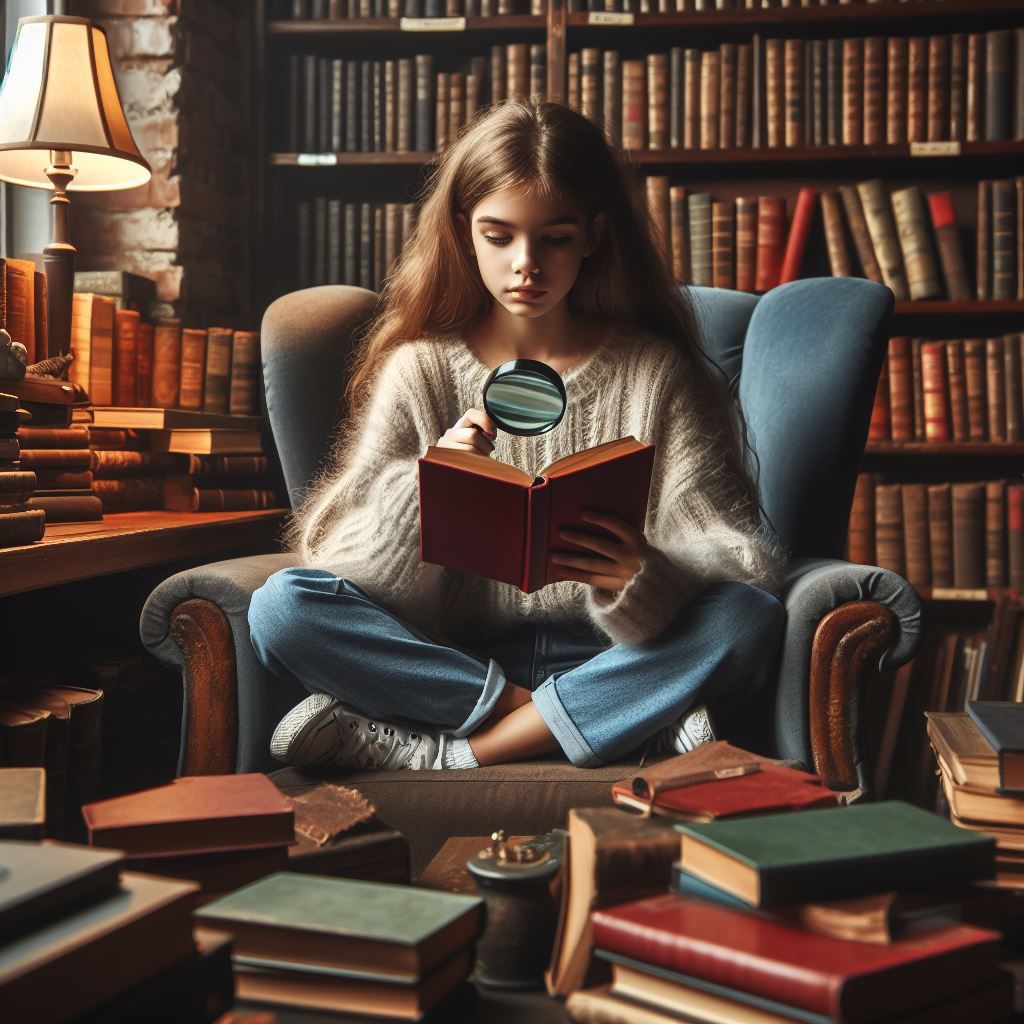
Certainly! Mrs. Eleanor’s teaching methods were as captivating as her storytelling. Let’s delve deeper into her enchanting approach:
- Narrative-Based Learning:
Mrs. Eleanor believed that stories were the gateway to understanding. She wove narratives into every lesson, whether teaching history, science, or mathematics. For instance, when explaining the Pythagorean theorem, she’d recount the tale of Pythagoras and his mystical triangle. Students leaned in, wide-eyed, as if unraveling secrets hidden in the folds of ancient scrolls. - Socratic Questioning:
Like a gentle breeze stirring leaves, Mrs. Eleanor’s questions guided students toward discovery. She’d ask, “Why do you think the protagonist made that choice?” or “What if gravity worked differently?” These open-ended inquiries sparked curiosity, encouraging students to explore ideas independently. - Hands-On Exploration:
Mrs. Eleanor transformed her classroom into a laboratory of wonder. When studying ecosystems, students became ecologists—collecting leaves, observing insects, and mapping food chains. “Learning,” she’d say, “isn’t confined to textbooks; it’s in the touch of soil and the rustle of leaves.” - Peer Collaboration:
The oak tree witnessed countless huddles beneath its branches. Mrs. Eleanor fostered collaboration, pairing students with diverse strengths. “Together,” she’d say, “you’ll create symphonies of knowledge.” Whether solving equations or writing essays, students leaned on each other, their roots intertwining. - Metaphorical Bridges:
Mrs. Eleanor loved metaphors. She’d compare algebraic equations to bridges—connecting known shores to uncharted islands. “Solve for x,” she’d say, “and you build a bridge to new realms.” Students scribbled equations, imagining themselves as architects of possibility. - Celebrating Mistakes:
“Mistakes,” Mrs. Eleanor declared, “are stepping stones, not stumbling blocks.” When a student stumbled, she’d smile and say, “Ah, a detour! Let’s explore.” She celebrated wrong answers, turning them into springboards for deeper understanding. - Individualized Growth Plans:
Mrs. Eleanor knew her students intimately—their dreams, fears, and quirks. She tailored learning paths accordingly. For a struggling reader, she’d recommend magical tales; for a budding scientist, complex experiments. “Each of you,” she’d affirm, “blooms at your own pace.” - Joyful Assessments:
Tests weren’t dreaded storms in Mrs. Eleanor’s class; they were meteor showers—brief, brilliant, and awe-inspiring. She’d set puzzles, riddles, and creative challenges. “Show me your constellations,” she’d say, eyes twinkling. Students beamed, eager to share their celestial brilliance. - Legacy-Building Rituals:
At year’s end, Mrs. Eleanor held a “Book of Wisdom” ceremony. Each student contributed—a quote, a drawing, a lesson learned. The oak tree cradled these pages, whispering secrets across generations. “You,” she’d tell her students, “are ink in this living book.”
And so, Mrs. Eleanor’s classroom became a realm of wonder—a place where magic danced with knowledge, and hearts bloomed like wildflowers. Her legacy? Written not in ink, but in the spark of curiosity ignited within her students.
Sources:
- Edutopia
- TeachThought
- Conversations with Mrs. Eleanor’s former students (anecdotal evidence)
Image: Pixabay

 kohsarblog
Leave a comment